Creating Fractions on Number Lines
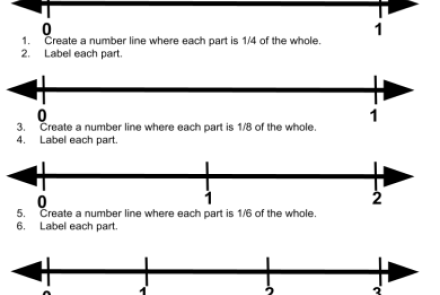
In this 3rd Grade worksheet, students will create fractions on number lines. They will label each part of the fraction.
In this 3rd Grade worksheet, students will create fractions on number lines. They will label each part of the fraction.
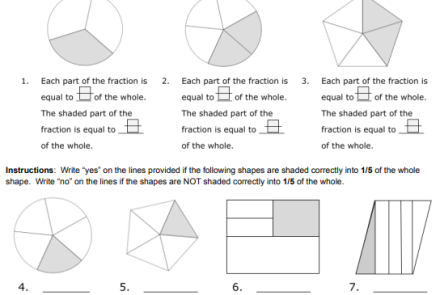
This fractions worksheet is designed to reinforce the concept that fractions are shapes or objects divided into equal parts or pieces. Students are first asked what each part of a divided shape is equal to. Then they have to make a fraction based on the shaded area. Next students are presented with shapes that are divided into 1/5 and have to decide whether or not the shape was evenly divided. Finally, they are given 2-word problems designed to make a student think about what each part of a divided shape or object actually means.
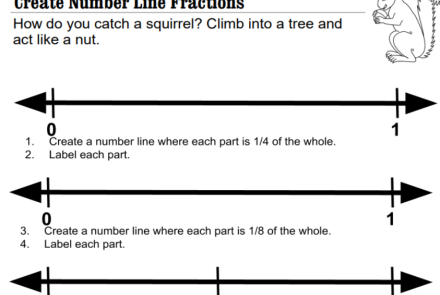
Students will learn to split a number line equally to represent fractions. The fractions can represent more than one whole and therefore can be written as improper fractions. The last question has student place fractions on a number line. This math worksheet has 5 number lines.
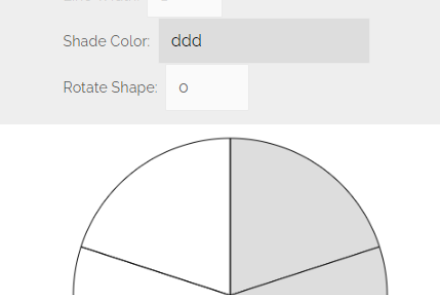
This web tool can allow teachers to build images that represent fractions of circles/pies or polygons. It is simple to use. Just say how many equal parts you want to be represented and then how many parts to shade. You can also determine the line width, shade color, and rotate the shape. Once finished take a screen show of the picture or right-click and save the image.
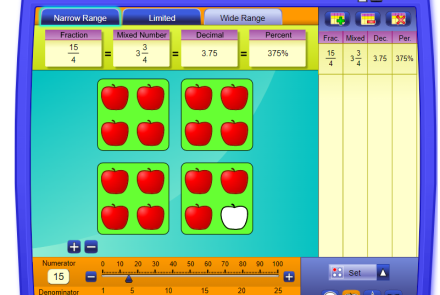
This website allows students and teachers to visually explore fractions and how they relate to mixed numbers, decimals, and percents. You can set it up by area, region, or set of items. Once you select a fraction it will then demonstrate to students how that relates to mixed numbers, decimals, and percents.
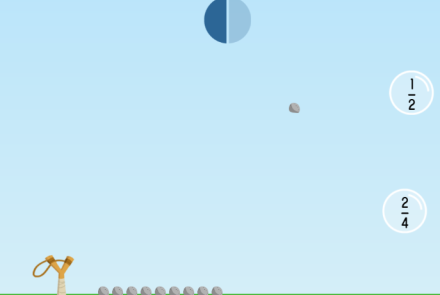
In this game, students will identify a fraction and then shoot the correct bubble that contains that particular fraction. As kids get better the bubbles get faster and more fractions to choose from.
This is a one-minute video that demonstrates to students that shapes can be evenly split and that each piece is one equal part of the whole shape.
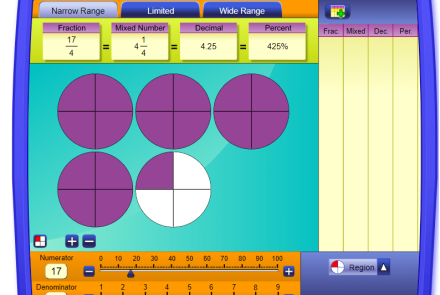
Explore different representations for fractions including improper fractions, mixed numbers, decimals, and percentages. Additionally, there are length, area, region, and set models. Adjust numerators and denominators to see how they alter the representations and models. Use the table to keep track of interesting fractions. If your students have computers, yell out fractions and have them create the fraction you called.
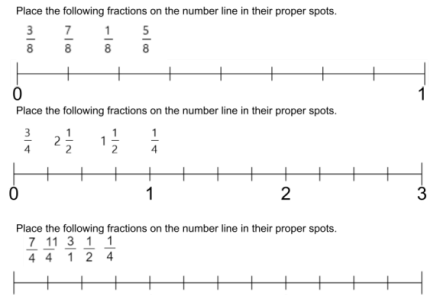
This is a review of placing fractions on number lines. There are regular fractions lower than 1, mixed fractions, and improper fractions. At the end, students will create their own number line.
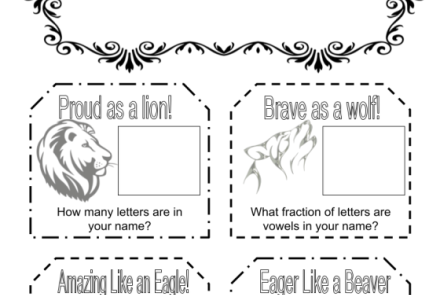
I use this elementary math activity to reinforce the concept of fractions of items. In this case, the items or objects are the letters in their name. First students will write their first and last names inside a decorative border. Next, they count how many letters total, how many vowels and consonants their names contain, and how many letters are the same as the first letter in their names. They will then create fractions based on their answers. This is also an activity to subtly or not so subtly build self-esteem.