x

Modeling Air Convection Currents and High and Low Pressure Systems
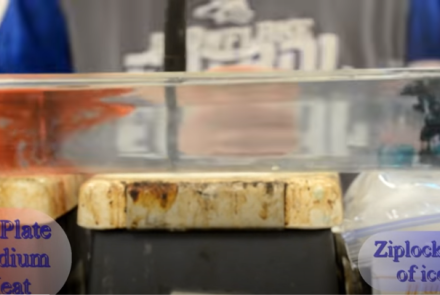
In this lab I have students observe what happens to water, which represents air, warms up and what happens to water as it cools down. Using a hot plate, a large glass cake pan, a bag of ice and food coloring can easily demonstrate how wind is formed. The demonstration can also be used in topics of high/low pressure, warm and cold fronts, mantle convection if you would like. The assignment, however, is for high and low pressure systems and wind.
Earth Science Demonstration: Chocolate Plate Tectonics

Here is a plate tectonic demonstration/lab idea for all grade levels.  You can easily use this video when teaching about earthquakes and plate movements.  All you will need is a hot plate, pan, some milk and chocolate powder.  Place the pan on the hot plate, pour in some milk, pour a thick layer of chocolate powder on top of the milk until the milk is covered.  Turn on the hot plate and then wait a few minutes up to about 5 and you should start to see the "crust" break apart and "magma" rise to the surface.  Extension in your conversation can be:

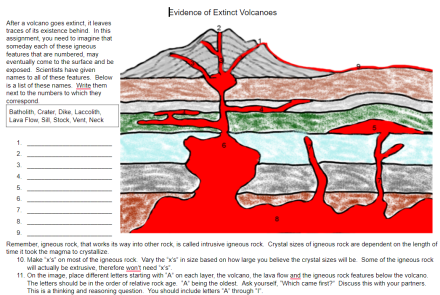
Earth Science: Evidence of Volcanic Past

In this Earth Science/Geology assignment, students will gain a better understanding of igneous rock formation and the evidence left behind when a volcano goes extinct. Students will label a diagram that contains: a batholith, a crater, dikes, a laccolith, a lava flow, sills, a stock, a vent, and a volcanic neck.

Students will reinforce the concept of intrusive and extrusive igneous rocks by placing representations of relative crystal sizes on the diagram.


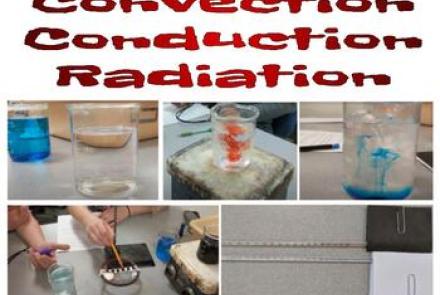
Convection, Conduction Radiation Thermal Energy Transfer Lab

In this Earth Science or Physical Science lab, students will gain an understanding of the three types of thermal energy transfer: conduction, radiation, and convection. Students will use hot, cold, and room temperature water to demonstrate convection by using food coloring. Students will then see how long chocolate chips take to melt when you add heat to just one side of some tin foil. Finally, they will use heat lamps, thermometers, and dark and light-colored papers to demonstrate radiation and the absorption of radiated heat.

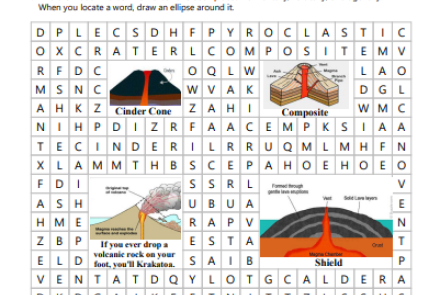
Volcano Vocabulary Word Search and Crossword

Two volcano vocabulary activity worksheets. The first one is a 20-word search. The word search contains images of a shield, cinder, and composite volcano. There are some fun volcano puns that encourage reading and are fun to share. The second worksheet is a crossword puzzle containing a word bank with more words than students need. This helps eliminate students counting how many boxes there are for each word.

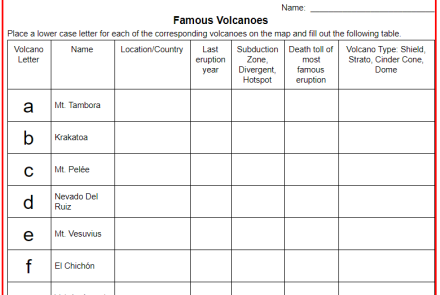
Famous Volcanoes

In this web research activity, students will research 14 volcanoes via the internet. All of these volcanoes are famous for either their size of eruption or the continuous eruptions that they have. They are famous for causing large tsunamis, huge pyroclastic flows, and lahars, as well as some that might not be so dangerous but have flowed continuously for many years. Students will enhance their geography knowledge by plotting the volcano's location on a plate tectonic map. They will find out when the last eruption occurred.

Consequences of Supervolcanoes Video

In this informative video, students will learn about the 1816 "Year without a Summer" and the devastating impact that it had on the world. The video explores the eruption of Mt. Tambora, and how it caused a worldwide climate crisis. Additionally, the video discusses other volcanic eruptions that have caused global disasters, including the supervolcano located in Yellowstone National Park. This video is a great resource for students studying natural disasters and their effects on the environment.

Subscribe to Volcanoes