x

Mineral ID Dichotomous Key Practice

This is an assignment I give my students before they actually take their mineral identification test. In this activity, the minerals have already gone through the individual characteristics tests such as luster, hardness, color, streak, and other mineral properties. This assignment is to give students practice using a dichotomous key that can help them identify minerals. This assignment also contains vocabulary words commonly used when identifying minerals.

For more Earth Science labs and resources visit EarthScience.xyz

Modeling Air Convection Currents and High and Low Pressure Systems

In this lab I have students observe what happens to water, which represents air, warms up and what happens to water as it cools down. Using a hot plate, a large glass cake pan, a bag of ice and food coloring can easily demonstrate how wind is formed. The demonstration can also be used in topics of high/low pressure, warm and cold fronts, mantle convection if you would like. The assignment, however, is for high and low pressure systems and wind.

Google Drawing and Diagram: Fault Types and Forces

In this EdTech Earth Science activity, students will use Google Drawing to create an image that demonstrates the three main types of earthquake faults, Transverse, Normal, and Reverse. They will find 2 real images of each type of fault. They will draw arrows pointing in the direction that the forces, shear, compression, and tension are moving on each image. They will also find and add an actual diagram of each type of fault. Finally, students will label the hanging wall and footwall on each image except for the transverse/strike-slip.

Erosion: Angle of Repose Lab

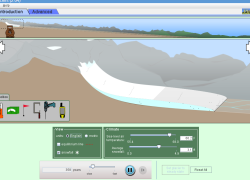
In this lab, students will take piles of sand and determine what the sand's angle of repose is. Students will compare 4 trials and see at how many degrees slope will the sand be able to handle before it has a landslide. There is math involved in this process. Students will then answer some questions based on their observations.

For more Earth Science labs and activities, visit EarthScience.xyz

Exploring Landforms of North and South America

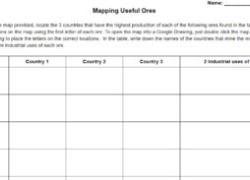
In this assignment, students will explore 25 features found in North and South America. They will circle, outline, and label specific locations on maps of North and South America. In the teacher instructions, you can also find a link to a Presentation that shows and discusses the geology and uniqueness of many of these locations.

For more Earth Science labs and resources visit EarthScience.xyz

Exploring River Formation Earth Science Lab

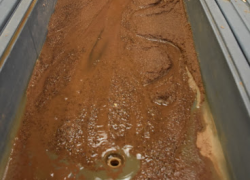
In this observation lab, students will use stream tables to observe how rivers form. When students are done they will understand how natural landslides can cause river course changes, how meanders are formed, how heavier sediment gets deposited quicker than lighter sediment like silt and clay, why rivers take the path they do, and how deltas are formed. Teacher notes, observations, suggestions, an answer key, and reflections are included.

For more Earth Science activities and resources visit, EarthScience.xyz

Earth Science Absolute Dating Lab

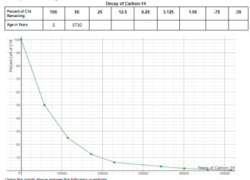
In this earth science lab, students will flip M&Ms/Skittles to help them gain a better understanding as to what absolute dating is. Students will learn what radioactive elements are and how scientists use this understanding to give an age to rocks and fossils. Students will create a spreadsheet and create a graph that will visually demonstrate the half-life of Carbon 14. There are 6 word problems that they will analyze to help them understand how to use a half-life graph.

Earth Science Demonstration: Chocolate Plate Tectonics

Here is a plate tectonic demonstration/lab idea for all grade levels.  You can easily use this video when teaching about earthquakes and plate movements.  All you will need is a hot plate, pan, some milk and chocolate powder.  Place the pan on the hot plate, pour in some milk, pour a thick layer of chocolate powder on top of the milk until the milk is covered.  Turn on the hot plate and then wait a few minutes up to about 5 and you should start to see the "crust" break apart and "magma" rise to the surface.  Extension in your conversation can be:

Subscribe to Lab