x

Relative Humidity and Dew Point Lab

In this Earth Science Lab, students will gain an understanding of what relative humidity and dew point are. There are four parts to the lab. The first part will help them understand the relationship between the ability to evaporate and humidity. Students will then use psychrometers to determine the humidity outside as well as inside. They will calculate the wet-bulb depression and then use the relative humidity chart to determine the percent of water in the air outside and inside the classroom.

Researching Metamorphic Rocks

Students will research 8 common metamorphic rocks. Marble, quartzite, hornfels, slate, phyllite, schist, gneiss, and amphibolite. Students will have a better understanding of what foliated vs. non-foliated rocks look like. They will understand what a parent rock is and review some of their mineral knowledge by researching what some of the most dominant minerals are in these particular metamorphic rocks. Finally, when they are done they will discuss with their groups some higher-order thinking questions that will drive the class discussion when the assignment is completed.

Rock Tumbler Abrasion Lab

In this activity students are going to find a small rock, decide what rock type it is, weight it, place it in a tumbler and then over a two week period observe it to see how much mass a rock can lose if it went through a 24 hour a day process of bouncing around other rocks. Students will get a first-hand look at the power behind water and abrasion. Students will make a statement of conclusion and calculate the rate of mass decrease.

For more Earth Science labs and resources visit EarthScience.xyz

Identifying Sedimentary Rocks

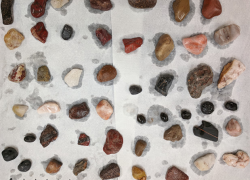
In this activity, students will hone their observation, inference, and making conclusions skill by trying their best to use a dichotomous classification key to determine the name of their rocks. This Earth Science lab also contains a dichotomous key used for teaching students how sedimentary rocks are classified.

Find more Earth Science lessons and labs at EarthScience.xyz.

Other rock and mineral identification labs can be found at:

Igneous Rock Identification Lab

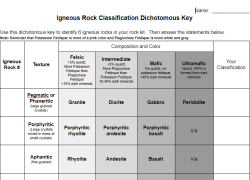
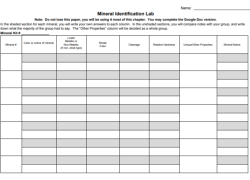
In this lab, students will identify up to 6 igneous rocks. They will practice using a dichotomous key in order to ID their rocks. Students will have a better understanding of igneous rock texture, composition, and color. There are four questions at the end of the lab that will review crystallization, intrusive and extrusive rocks. I give this assignment after our study on igneous rocks, so this is a great assessment activity as well. I have also included my own thoughts and instructions to help you implement this activity in your classroom.

Jobs in Earth Science Investigation

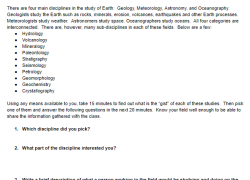
In this activity, students will briefly examine 10 fields/disciplines of Geology: hydrology, volcanology, mineralogy, paleontology, stratigraphy, seismology, petrology, geomorphology, geochemistry, and crystallography. They will pick one of those disciplines that they find interesting and find a job description in that field. Students will also find a salary range and what type of education they would need in order to obtain that salary. When students are finished, they should have an idea that there are money and great careers as a scientist in the field of Geology.

Measure Distance using the Metric System while flying pens across the classroom

This science lab can be used in any of the science disciplines because it is going to help students learn how to read a meter tape. Students will learn what the Magnus Effect is and how to demonstrate the Magnus Effect by "flying" a hollowed-out "Bic" pen across the classroom. Students will also learn how to create a spreadsheet and then add a formula that will automatically calculate the average of their pen flight distances. I use this lab at the beginning of the year to get students excited about science as well.

Mechanisms and Agents of Weathering Presentation

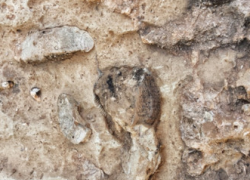
In this assignment, students will find images of rocks and rock formations that demonstrate that weathering has occurred. They will create a Google presentation that demonstrates the mechanisms and agents of weathering involved. They will also describe the type of climate that would have helped form this rock. Students will then present their findings to the class. Hopefully, you will get many different images of awesome rock formations.

For more Earth Science labs and lessons visit, EarthScience.xyz.

Subscribe to Lab