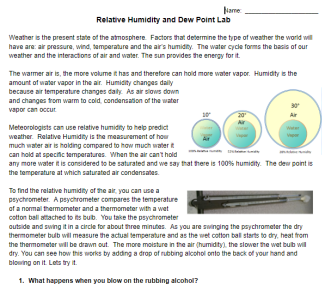
In this Earth Science Lab, students will gain an understanding of what relative humidity and dew point are. There are four parts to the lab. The first part will help them understand the relationship between the ability to evaporate and humidity. Students will then use psychrometers to determine the humidity outside as well as inside. They will calculate the wet-bulb depression and then use the relative humidity chart to determine the percent of water in the air outside and inside the classroom. Students will then use an online dew point calculator that will use the data gathered from their psychrometers to calculate the dew point both for the outside and the inside of the classroom. The class will then discuss the relationship between humidity and mold. Finally, students will use thermometers, ice, and water and calculate the dew point in the classroom and compare their results with what the online dew point calculator gave them. During this lab, students will get two opportunities to formulate a hypothesis. Classroom participation and discussion will be fantastic during this lab. Answer key, teacher reflection and notes, and lab instruction are included.
For other Earth Science activities and content, visit EarthScience.xyz