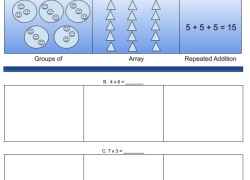
Students will apply and model various multiplication strategies including arrays, groups of, and repeated addition. They demonstrate understanding by solving seven problems.
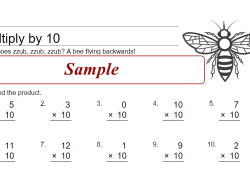
Students will build multiplication fact fluency 2-12 using timed tests, aiming for speed and accuracy. Engaging daily practice includes fun facts, jokes, and pictures to trace or color.
Students master division facts by matching quotients to equations or vice-versa. This festive Halloween bingo game engages learners with spooky math practice, perfect for skill-building.
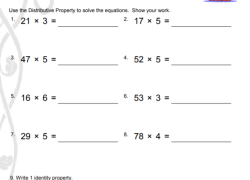
Engage elementary students with distributive property practice, finding products. They will also review identity, zero, commutative, and associative properties, solidifying foundational math understanding.
Engage 3rd graders with a fun dice game to master multiplying by 10. Students roll, calculate products, and sum results while competing to achieve the highest score.
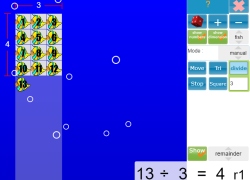
Help students visually explore division through arrays, understanding estimation, factoring, and remainders. Students will discover prime factors, perfect squares, and division's relation to fractions.
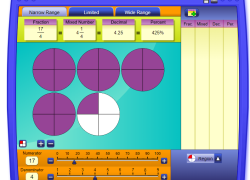
Students explore improper fractions, mixed numbers, decimals, and percentages. They manipulate numerators/denominators to build and understand various length, area, and set models.
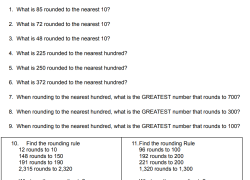
Support students struggling with rounding to master key concepts. Through focused discussion of targeted questions, students will clarify misconceptions and strengthen their number sense.
Students will master 3rd-grade division strategies: arrays, number lines, and repeated subtraction. They will sharpen problem-solving skills with engaging task cards or game play.
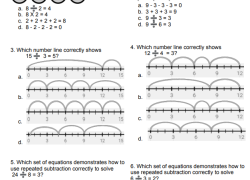
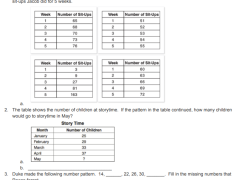
Students practice identifying various number patterns and confidently partitioning shapes into equal parts. This review solidifies foundational understanding, preparing them for more complex mathematical concepts.
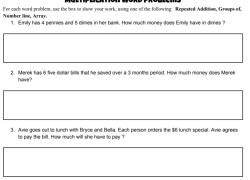
Engage students with 10 word problems, strengthening multiplication and division skills. They demonstrate problem-solving using strategies like arrays, repeated addition, and equal groups.
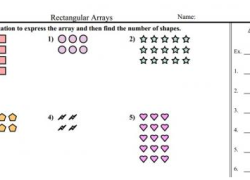
Students will count rows and columns in arrays to build multiplication understanding. They then multiply to solve problems and write the corresponding equations.