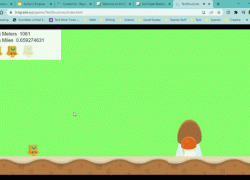
Students navigate an obstacle course, answering text structure questions to continue. They'll practice identifying sequence, cause/effect, problem/solution, and more, aiming for a 10-mile run.
Students will discover how quartz minerals form and become sand. They will learn about mineral formation, sand dunes, river deposition, and erosion processes.
Students explore their own hearing age and learn the science behind sound perception. Engaging content clearly demonstrates this fascinating scientific concept, fostering student understanding of auditory health.
Help students visualize the incredible, tiny scale of atoms. They will learn about atomic size through compelling comparisons, enhancing their grasp of fundamental atomic structure concepts.
Students will investigate the heart's intricate mechanics, understanding how it efficiently circulates blood. They will explore the vital function of the ventricle system.
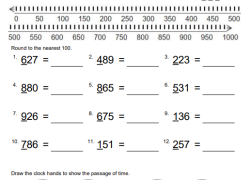
Help 3rd graders master rounding to the nearest hundred, supported by visual number lines. Students will also sharpen their skills with two elapsed time review questions.
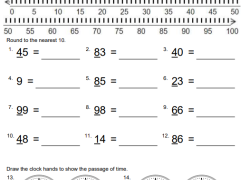
Students practice 3rd-grade rounding to the nearest ten with number line support. They will also solve two elapsed time problems to strengthen math skills.
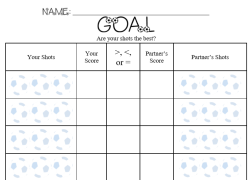
Engage students in an interactive game practicing addition and number comparison skills. They will improve their greater than, less than, and equal to fluency through dice rolls and competitive scoring.
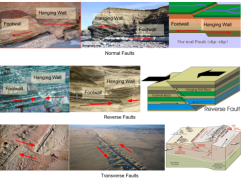
Students will use Google Drawing to create diagrams of earthquake fault types. They will identify real-world examples, apply forces like shear and tension, and label key geological structures.
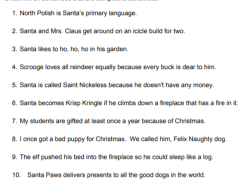
Engage students with a festive grammar review! They will identify nouns, verbs, pronouns, adverbs, and adjectives in Christmas-themed puns using different colors.