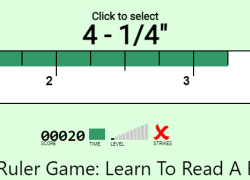
Engage students with an interactive game where they master ruler measurements. Students practice reading inches to sixty-fourths, building accuracy and speed as they progress.
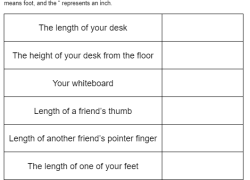
Engage students in hands-on practice measuring to the nearest quarter inch. They use a ruler to measure classroom objects and more, building practical skills in this customizable lab.
Students dive into estimating water volume in diverse containers. They measure with graduated cylinders, then compare their predictions to actual amounts for engaging learning.
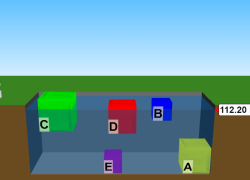
Students will understand mass, volume, and density concepts. They will digitally manipulate object volumes, measure masses, and calculate densities using an interactive simulation.
Students discover the Magnus Effect by flying pens across the classroom. They will practice measuring distances using the metric system and analyze data with spreadsheets.
Students will analyze the mathematical principles behind levers, discovering how they reduce effort. They'll also explore Archimedes's foundational work and experiments in physics.
Students explore the metric system's origin and its scientific benefits. Bill Nye then guides them through understanding fundamental metric length measurements in this engaging math video.
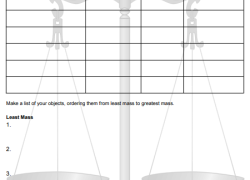
Students will estimate and then accurately measure the mass of everyday objects using balance scales. They will describe, weigh, calculate differences, and sort from lightest to heaviest.