x

Earth Science Salt Crystal Formation Lab

In this 3rd through 10th-grade lab, students will observe the formation of salt crystals. Students will also add food coloring to their dissolved salt solution to demonstrate how chemical impurities can change a mineral's color. If you have enough students doing the lab your class will get to see many different results. This Earth Science lab comes with the student work, student image sample results, and with my own insights and explanations as to how the experiment can work well.

Find more Earth Science labs and lessons at EarthScience.xyz

Earth Science: What's in that Mineral? Activity

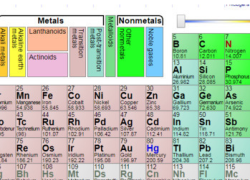
This Google search activity allows students to go to the internet to search for specific minerals and then to use the Periodic Table to discover what elements the mineral is made out of. This activity usually takes a full 50 minutes for the students to find all of the answers. Students will investigate 12 different minerals and which elements make the mineral up. They will look at a periodic table and decide whether the elements are metals or nonmetals. Students will also search the internet and find out some industrial uses for each mineral.

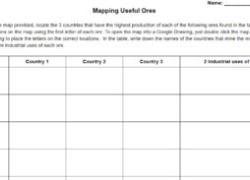
Earth Science: Mapping Useful Ores Research Activity

In this assignment, students will open up a Google Doc, you can have it printed as well, and fill out a table of some very useful industrial ores. The ores that will be researched are diamonds, gold, rock salt, bauxite, iron, and titanium. Students will research which 3 countries in the world are the top producers of each ore. They will then find and write 2 or more industrial uses for each ore. As they are doing their research, students will also use a map and mark where these countries are. This is great to reinforce the geography standards.

Earth Science: What's in that Mineral? Activity

This Google search activity allows students to go to the internet to search for specific minerals and then to use the Periodic Table to discover what elements the mineral is made out of. This activity usually takes a full 50 minutes for the students to find all of the answers. Students will investigate 12 different minerals and which elements that make up each mineral. They will look at a periodic table and decide whether the elements are metals or nonmetals. Students will also search the internet and find out some industrial uses for each mineral.

The Rock Cycle Activity

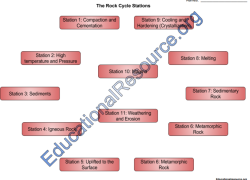
Looking for a new way to teach the rock cycle? Check out this exciting twist on a classic activity from EducationalResource.org! In this activity, students roll a die and follow instructions to create their own unique rock cycle. This hands-on approach helps students understand that there is no one set path for a rock to follow as it undergoes the process of becoming a new type of rock. As a class, students can share their individual rock cycle paths and compare them to see the infinite possibilities that exist within the rock cycle.

Subscribe to Rocks and Minerals