Challenge students to identify and correct spelling errors in ten sentences. They will find and circle misspelled words, then write the correct spellings.

Students engage with the scientific method, honing grammar skills. They practice writing complete sentences to document experiment observations and insightful conclusions effectively.
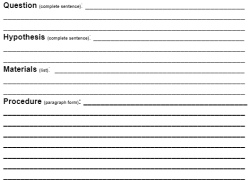
Students follow instructions to grow beans, tracking daily changes and recording observations. They'll integrate hands-on science with technical reading comprehension and observation skills.
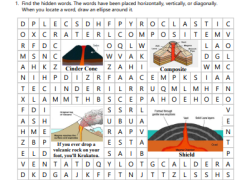
Students will explore volcano vocabulary using a word search and crossword puzzle. They will identify and learn terms like ash, lava, and eruption in engaging activities.
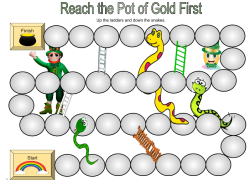
Engage 3rd graders with this St. Patrick's Day Snakes and Ladders game. Students use game cards to practice various skills, making learning fun and interactive.
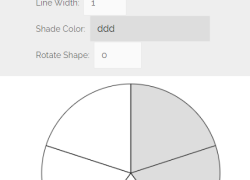
Create custom visuals of fractional parts using circles and polygons. Students will visualize and better understand parts of a whole in your lessons and assignments.
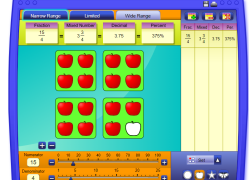
Students visually understand fractions and their equivalence as mixed numbers, decimals, and percents. Interactive tools demonstrate these relationships using various models.
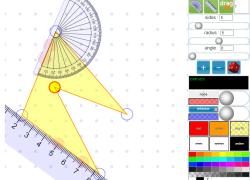
Students actively explore polygons and quadrilaterals, manipulating shape properties and angles. They learn about interior/exterior angles and virtually practice using protractors and rulers.
Engage students in a compelling discussion on scientific experimentation. Learners analyze three studies demonstrating how focused thought can influence actions and real-world outcomes.
Help students understand energy concepts with this quick video. They will learn about chemical, nuclear, and dark energy, gaining foundational knowledge easily.
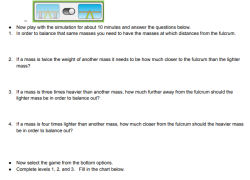
Your students will explore lever balancing in a Phet simulation. They investigate mass and distance relationships from the fulcrum and calculate mechanical advantage.
Engage students in opinion essay writing using two passages on cell phone ownership. A 5-paragraph sample essay helps them develop arguments and structure their own essays.
