The Water Cycle Video
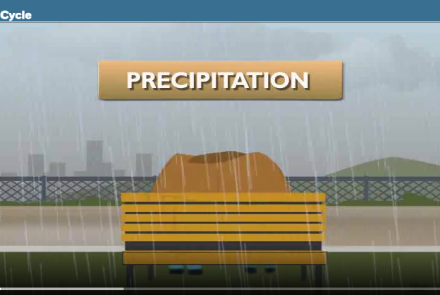
In this Study Jam video, students will learn about the water cycle. The vocabulary used in the video is precipitation, evaporation, condensation, humid, transpiration, clouds, dense, and water vapor.
In this Study Jam video, students will learn about the water cycle. The vocabulary used in the video is precipitation, evaporation, condensation, humid, transpiration, clouds, dense, and water vapor.
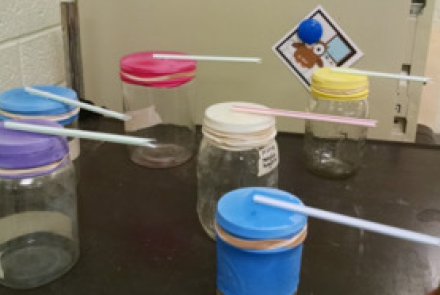
In this Earth Science lab, students will create their own homemade barometers using a canning jar, a balloon, and a straw. The barometers can show low and high-pressure systems. After they build their barometers, students will complete a daily log, by measuring the height differences of their barometers. They will determine rising and falling barometers. Students will also observe the weather that is currently outside.
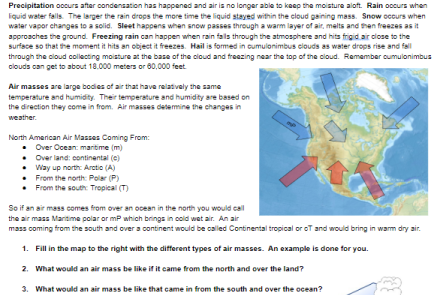
Turn your students into meteorologists with this engaging, real-world weather activity!
Move beyond static textbook diagrams and get your students analyzing live data. This comprehensive lesson and lab helps students understand the complex relationships between air pressure, air masses, and weather fronts using current, real-time surface maps.
Perfect for 7th Grade through High School Earth Science, this resource combines literacy, theory, and digital investigation to ensure students master meteorology concepts.
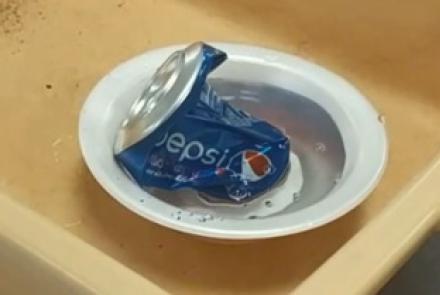
In this Earth Science lab, students will crush a soda can using atmospheric pressure. This is a common science experiment with a twist. In this version, students will calculate the total air pressure found on the outside of the can. The kids will take the surface area formula of a cylinder and find out about how many pounds of air is sitting on top of and around the can. This lab also attempts to incorporate math into a science class.
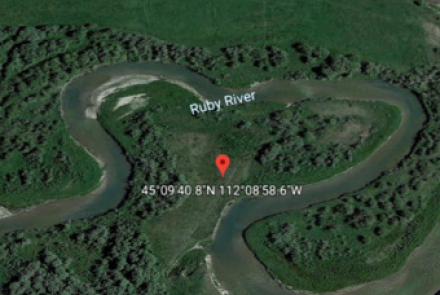
In this Earth Science digital activity, students will locate specific water eroded or deposited landforms. The activity will enhance their understanding of Geo Coordinates. Students will use Google Earth and become more proficient with its use. Students will see actual satellite views of their vocabulary words instead of just memorizing the definitions. Vocabulary words that will be reinforced are Meanders, oxbow lakes, sediment, river types (old, mature, young), delta, deposition, erosion, alluvial fan, and flood plain.
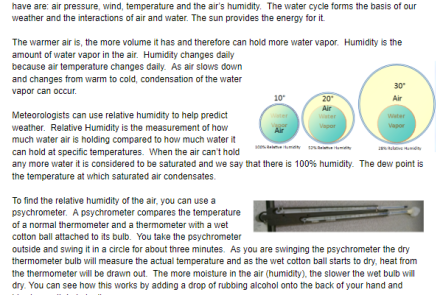
In this Earth Science Lab, students will gain an understanding of what relative humidity and dew point are. There are four parts to the lab. The first part will help them understand the relationship between the ability to evaporate and humidity. Students will then use psychrometers to determine the humidity outside as well as inside. They will calculate the wet-bulb depression and then use the relative humidity chart to determine the percent of water in the air outside and inside the classroom.
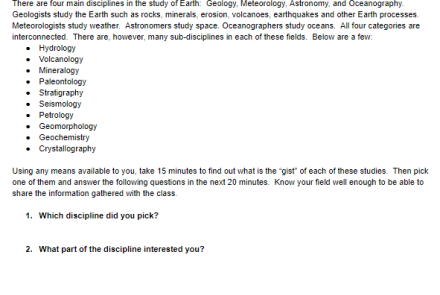
In this activity, students will briefly examine 10 fields/disciplines of Geology: hydrology, volcanology, mineralogy, paleontology, stratigraphy, seismology, petrology, geomorphology, geochemistry, and crystallography. They will pick one of those disciplines that they find interesting and find a job description in that field. Students will also find a salary range and what type of education they would need in order to obtain that salary. When students are finished, they should have an idea that there are money and great careers as a scientist in the field of Geology.
This TEDed video shows just how big the ocean is. It does a great job at putting the sheer size of the ocean into perspective.
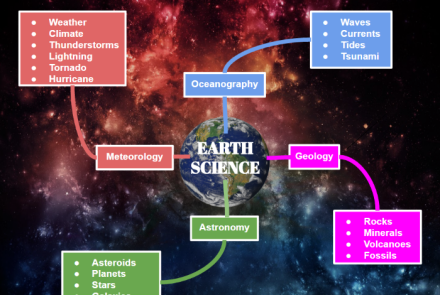
In this Google Drawing activity, students will create a concept map using the following words: Earth Science, geology, waves, currents, astronomy, oceanography, stars, volcanoes, planets, meteorology, fossils, weather, climate, rocks galaxies, thunderstorms, tides, tsunamis, lightning, comets, minerals, asteroids, tornadoes, hurricanes, and earthquakes.
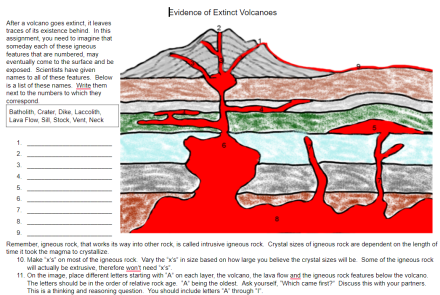
In this Earth Science/Geology assignment, students will gain a better understanding of igneous rock formation and the evidence left behind when a volcano goes extinct. Students will label a diagram that contains: a batholith, a crater, dikes, a laccolith, a lava flow, sills, a stock, a vent, and a volcanic neck.
Students will reinforce the concept of intrusive and extrusive igneous rocks by placing representations of relative crystal sizes on the diagram.