Grammar Christmas Review Worksheet
Using colored pencils or crayons, students will read some Christmas puns and then identify nouns, verbs, pronouns, Adverbs, and Adjectives with different colors.
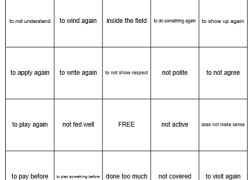
In this Halloween version of bingo, teachers can call either the quotient or the equation. There are 30 cards where the teacher calls the quotient and students find a valid equation and 30 cards where the teacher calls the equation and students find an equal quotient.
The cards come with Halloween clip art that allows students to doodle or color in as well.
This activity is great for the days leading up to and on Halloween when students become very spooky themselves.
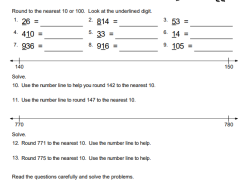
A simple worksheet to give students a chance to practice calculating elapsed time using a number line. The directions instruct students to label the number line and to circle their final answer. The problems are based on actual students and activities that they enjoy! This practice sheet also features a clock for fast-finishers to color.
This worksheet provides students with three problems to practice finding start time by labeling and using a number line. The directions instruct students to label each number line and then to draw a dot on where they believe the start time is on their number line. Questions are based on actual students and things that they enjoy to do in real life! This worksheet includes a clock that fast-finishers can color.
This 3rd Grade comparing and equivalent math worksheet was designed as an end of unit review. It contains 6 normal comparing fractions problems using <,>, and =. The worksheet has 2 fraction problems using number lines. It also has pie charts and bar charts divided into fractions. Finally, students will shade in the equivalent fractions on 4 rectangles that are divided into fractions.
This 3rd-Grade equivalent fractions worksheet has 6 pies and 5 bars divided into fractions. Students will use those charts to find the equivalent fractions. There is a bonus question where students will create their own equivalent fraction.
In this equivalent and comparing fractions review worksheet students will demonstrate their understanding of fractions. Students will illustrate their knowledge of comparing fractions using number lines and pie charts, the butterfly or cannon method of comparing fractions, a few word problems that compare fractions,s and finally demonstrate that they understand that a fraction with a denominator of 1 will be a whole number and a fraction that has the same denominator as the numerator is equal to one.
In this lab, students will take piles of sand and determine what the sand's angle of repose is. Students will compare 4 trials and see at how many degrees slope will the sand be able to handle before it has a landslide. There is math involved in this process. Students will then answer some questions based on their observations.
For more Earth Science labs and activities, visit EarthScience.xyz
In this assignment, students will explore 25 features found in North and South America. They will circle, outline, and label specific locations on maps of North and South America. In the teacher instructions, you can also find a link to a Presentation that shows and discusses the geology and uniqueness of many of these locations.
For more Earth Science labs and resources visit EarthScience.xyz
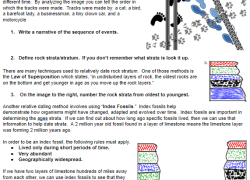
In this observation lab, students will use stream tables to observe how rivers form. When students are done they will understand how natural landslides can cause river course changes, how meanders are formed, how heavier sediment gets deposited quicker than lighter sediment like silt and clay, why rivers take the path they do, and how deltas are formed. Teacher notes, observations, suggestions, an answer key, and reflections are included.
For more Earth Science activities and resources visit, EarthScience.xyz