Challenge students to design an Earth Science experiment. They will determine which sediment type exhibits the greatest porosity and permeability through hands-on investigation.
Engage students to design an experiment investigating how surface area impacts physical weathering. They use Alka-Seltzer to model rocks, developing hypotheses and drawing conclusions on weathering rates.
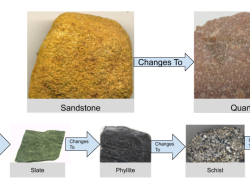
Students research eight metamorphic rocks, understanding foliated vs. non-foliated types, parent rocks, and key minerals. They'll engage in group discussions with higher-order thinking questions.
Engage students in a hands-on exploration of rock abrasion. They will classify, measure mass loss in a tumbler, and calculate change rates, revealing weathering's powerful impact.
Challenge students to classify sedimentary rock samples using a dichotomous key. They will hone observation, inference, and conclusion-making skills, discovering how these rocks are grouped.
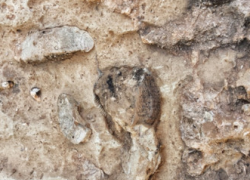
Engage students in identifying igneous rocks with a dichotomous key. They will explore texture, composition, and color, and review crystallization, intrusive, and extrusive rock formation.
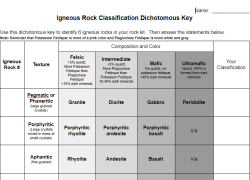
Students practice mineral identification using a dichotomous key. Given characteristics like luster and hardness, they learn to apply the key and master essential vocabulary before their test.
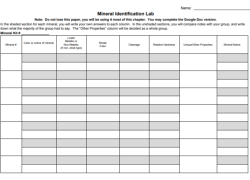
Students will master mineral identification in a 4-day lab. They will test streak, cleavage, luster, hardness, and other properties, then apply a dichotomous key.
Students will discover how quartz minerals form and become sand. They will learn about mineral formation, sand dunes, river deposition, and erosion processes.
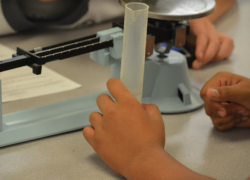
Students design and conduct an experiment to determine the densities of various rocks and minerals. They will apply scientific inquiry to calculate mass, volume, and density.
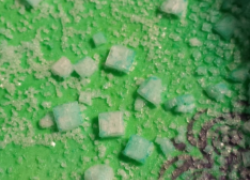
Students observe crystal formation and explore how impurities change mineral color in this Earth Science lab. Perfect for grades 3-10, it includes student work and sample results.
Students will research 12 minerals, identifying their elemental composition using the Periodic Table, and exploring their industrial uses.