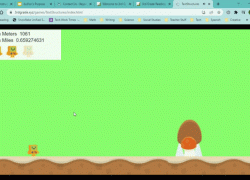
Students navigate an obstacle course, answering text structure questions to continue. They'll practice identifying sequence, cause/effect, problem/solution, and more, aiming for a 10-mile run.
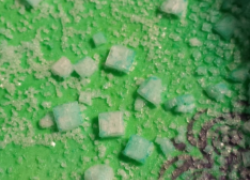
Students will discover how quartz minerals form and become sand. They will learn about mineral formation, sand dunes, river deposition, and erosion processes.
Students explore their own hearing age and learn the science behind sound perception. Engaging content clearly demonstrates this fascinating scientific concept, fostering student understanding of auditory health.
Help students visualize the incredible, tiny scale of atoms. They will learn about atomic size through compelling comparisons, enhancing their grasp of fundamental atomic structure concepts.
Students will investigate the heart's intricate mechanics, understanding how it efficiently circulates blood. They will explore the vital function of the ventricle system.
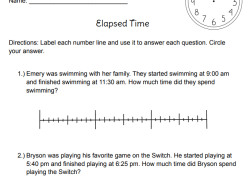
Students will practice calculating elapsed time on a number line, labeling it and circling answers. Relatable story problems will engage them, with a clock provided for coloring fun.
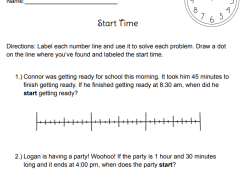
Students will practice finding elapsed time start points using number lines. Real-life problems make learning relevant, with a fun coloring task for early finishers.
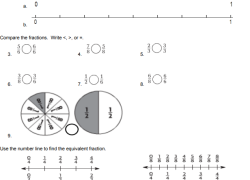
Students will practice comparing 3rd-grade fractions using symbols and number lines. They will also identify and shade equivalent fractions on various visual models, including charts. Excellent for review.
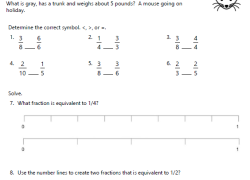
Students will explore equivalent and comparing fractions using number lines, diagrams, and word problems. They will strengthen their understanding of fraction properties and relationships.
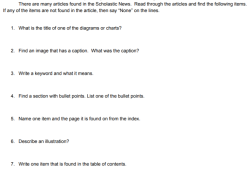
Students will locate and learn the purpose of various expository text features, including captions, diagrams, keywords, and glossaries, using any magazine.
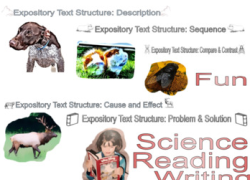
Guide students to identify and analyze various expository structures like description, sequence, and cause/effect. They will read texts, recognize signal words, and write their own structured examples.
Students observe crystal formation and explore how impurities change mineral color in this Earth Science lab. Perfect for grades 3-10, it includes student work and sample results.