x

States of Matter Video: What does it really mean to be a solid, liquid or gas?

In this science video, Veritasium does a fantastic job interviewing the public to see if they know what it actually means to be a solid, liquid or a gas.  It is fun to watch people try to remember from their schooling what the scientific answer is.  This would be a great video to show when introducing 3 of the 4 states of matter to your chemistry or physical science students.
Surface Water Landforms Google Earth Scavenger Hunt

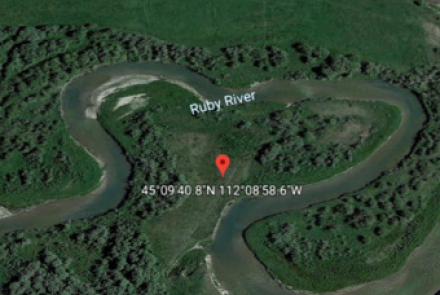
In this Earth Science digital activity, students will locate specific water eroded or deposited landforms. The activity will enhance their understanding of Geo Coordinates. Students will use Google Earth and become more proficient with its use. Students will see actual satellite views of their vocabulary words instead of just memorizing the definitions. Vocabulary words that will be reinforced are Meanders, oxbow lakes, sediment, river types (old, mature, young), delta, deposition, erosion, alluvial fan, and flood plain.

Jobs in Earth Science Investigation

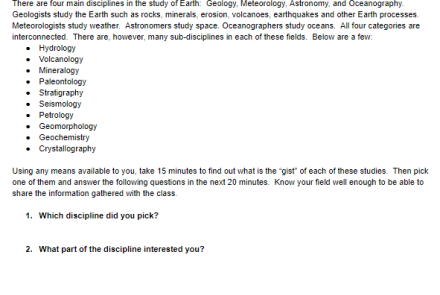
In this activity, students will briefly examine 10 fields/disciplines of Geology: hydrology, volcanology, mineralogy, paleontology, stratigraphy, seismology, petrology, geomorphology, geochemistry, and crystallography. They will pick one of those disciplines that they find interesting and find a job description in that field. Students will also find a salary range and what type of education they would need in order to obtain that salary. When students are finished, they should have an idea that there are money and great careers as a scientist in the field of Geology.

How small is an atom? Video

This video does an excellent job explaining the answer to the question, "How small is an atom?  It compares an atom to the size of a grapefruit and a blueberry.  It is amazing to visualize just how small atoms really are.
 If you happen to be teaching about atomic structure, this might help your students understand this particular scientific concept.

Why is it warmer the further underground you go?

In this video, viewers will learn about how Lord Kelvin attempted to determine the age of the Earth, as well as why the Earth becomes warmer as you go deeper into it. The video also covers various topics related to the Earth's structure, such as the layers of the Earth, convection currents, volcanoes, and plate tectonics. Whether you're a student studying geology or someone simply curious about the planet we call home, this video will provide a fascinating insight into the workings of the Earth.

Why is glass transparent? Video

Unlock the secrets of transparent glass with this captivating and informative video. Through stunning animations, the video unveils the science behind the creation of glass, shedding light on the crucial role played by silica, oxygen, and light in the process. This engaging educational resource offers valuable insights into the science behind everyday objects. Expand your knowledge today and watch this enlightening video.

Subscribe to Physical Science