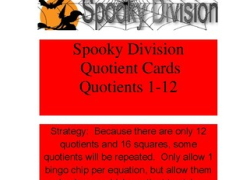
Students master division facts by matching quotients to equations or vice-versa. This festive Halloween bingo game engages learners with spooky math practice, perfect for skill-building.
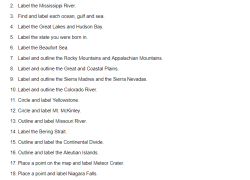
Guide students as they learn to identify, label, and map 25 major landforms spanning North and South America. An optional presentation enhances their geological understanding.
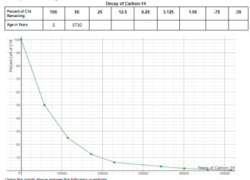
Students model absolute dating and half-life with candy. Graph Carbon-14 decay, solve problems, and apply probability to date rocks and fossils.
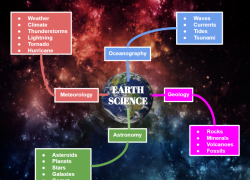
Students develop an Earth Science concept map in Google Drawing, connecting terms from geology, astronomy, and meteorology. They'll organize core concepts and use a collaborative tool. Rubric included.
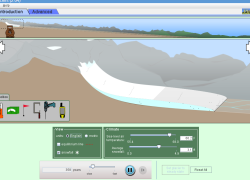
Students explore glacial formation, growth, and shrinkage. They act as scientists in an interactive lab, discovering how glaciers move and impact Earth's landscapes over time.
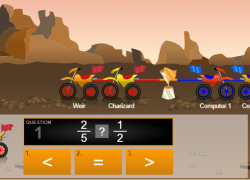
Students learn to assess fractional values in an engaging multiplayer tug-of-war game. They compete globally, building strong fraction skills and strategic thinking.
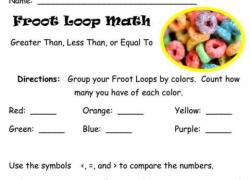
Engage students with a tasty math challenge! They count, sort, and compare quantities of colorful Fruit Loops, developing essential number comparison abilities through playful exploration.
Students will explore an animated comparison illustrating the vast scale differences between cells, bacteria, viruses, and cellular parts. Enhance their understanding of microscopic dimensions.
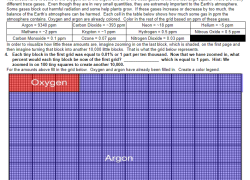
Students explore atmospheric gas composition, calculating parts per million and visualizing proportions. They learn the vital role of greenhouse gases in Earth's temperature balance.
Students enhance reading skills by answering context clues questions to destroy aliens. They also practice multiplication while clearing space junk, making learning an exciting challenge.
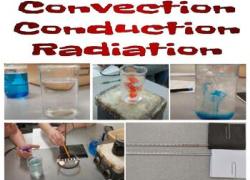
Students actively explore convection, conduction, and radiation through hands-on labs. They'll demonstrate principles using water, melting chocolate, heat lamps, and different colored papers.
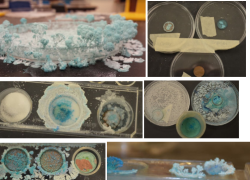
Challenge students to design and conduct their own penny oxidation experiment. They apply the scientific method, observe chemical weathering, and deepen content understanding through daily observations.